
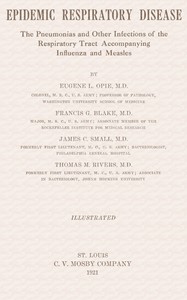
Epidemic Respiratory Disease by Opie, Blake, Rivers, and Small
Published in 1921, this book is the formal scientific report of a special investigation by U.S. Army doctors during the tail end of World War I. Their mission wasn't about bullets or trenches, but about a silent, far deadlier threat: the massive waves of respiratory illness sweeping through military camps. This was the so-called 'Spanish Flu,' and it was killing young, healthy soldiers at an alarming rate.
The Story
The 'story' here is the investigation itself. The book details their methodical, almost desperate work. They set up camp at Camp Cody, New Mexico, and Camp Pike, Arkansas, observing sick soldiers, taking samples, and running experiments. They document everything: symptoms, how the disease moved through a barracks, failed attempts to find a single bacterial cause, and their theories on transmission. You follow their logical steps and hit their dead ends with them. They grapple with the possibility of a 'filterable virus' (what we'd call a virus today) being the culprit, a radical idea at the time. The narrative is their scientific journey, a slow unveiling of a monster they can't quite see under the microscopes they have.
Why You Should Read It
This book is a time capsule. Reading it with modern knowledge is a haunting experience. You see these brilliant doctors so close to answers we now take for granted, yet limited by the science of 1918. Their meticulous notes on masks, isolation, and crowding read like today's public health guidelines. It makes our current pandemic experiences feel less like a unique tragedy and more like a recurring chapter in human history. There's a profound humility in seeing how they wrestled with the unknown. It’s not about dramatic heroes; it's about the grinding, essential work of science under pressure.
Final Verdict
This isn't a light read, but it's a profoundly rewarding one. It's perfect for history buffs, science enthusiasts, or anyone who lived through recent pandemic years and wants a deep historical mirror. You won't find characters to love, but you will find a real-world intellectual thriller. If you've ever wondered what it was actually like for the doctors in the middle of the 1918 flu pandemic, this is as close as you can get to being in the room. Just be ready to appreciate it as the groundbreaking—and sometimes heartbreaking—scientific document that it is.
This book is widely considered to be in the public domain. You can copy, modify, and distribute it freely.
Ava Clark
1 year agoBeautifully written.








Michael Johnson
10 months agoI had low expectations initially, however the author's voice is distinct and makes complex topics easy to digest. Thanks for sharing this review.