1

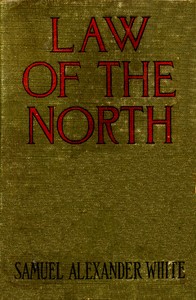
Law of the North (Originally published as Empery) A Story of Love and Battle in Rupert's Land — Key Ideas to Explore
(11 User reviews)
1334
Project Gutenberg
2013
Canada -- Fiction; Adventure stories
Readers of public-domain and historical texts
Project Gutenberg digital edition
en
Edition facts
Words: 54,518
Reading time: 238 min
Text sections: 6
Source:
Project Gutenberg record #41962
An editorial note examining the narrative voice and pacing in Samuel Alexander White's frontier adventure, focusing on the opening portage scene, the tracking of Gaspard Follet, and the use of French song to vary rhythm.
Editorial Edition Score
4.7/5
★★★★★
★★★★★
Calculated from edition completeness, EPUB availability, text structure and catalogue metadata. Not a user rating.
Edition quality
The opening of Law of the North (originally Empery) establishes a distinctive narrative voice that blends precise physical description with an undercurrent of tension. The courier Basil Dreaulond, hearing men on the Nisgowan portage, reacts with a trained, almost mechanical alertness: he hides his canoe, pack, and himself, then makes ready his weapons. The prose is economical, favoring concrete actions over internal commentary, and the setting—boulder-strewn woodland, tamarack thicket, blazed passage—is rendered with a surveyor's eye for detail. This opening suggests a world where survival depends on acute sensory awareness and swift, silent decisions.
The Rhythm of the Portage
The first chapter's pacing is deliberate, matching the physical effort of the portage. White uses short, declarative sentences to convey Dreaulond's movements: "He stopped automatically and trained his hearing in mechanical analysis of the sound." The narrative then slows to describe the hiding of the canoe and the creation of a peep-hole among "pungent boughs." This alternation between action and observation creates a rhythm that mirrors the courier's cautious advance. The arrival of the Nor'westers is deferred, building anticipation through the detailed scrutiny of the path—"flinty rock fragments, spear-like stumps, and a chaotic jumble of logs." The voice remains detached, reporting sensory data rather than emotion, which heightens the sense of professional competence under threat.
Tracking and the Voice of the Ojibway Runner
Later in the text, the narrative voice shifts when Maskwa, the Ojibway fort runner, takes the lead. His speech is terse and observant: "I made the shoes," he says of snowshoe tracks, identifying them by the curve of the knots. The dialogue between Maskwa and Chief Trader Dunvegan is clipped, with Maskwa's responses carrying an ironic edge—"The Little Fool is glad to meet with the Company's servants," he remarks after capturing Gaspard Follet. This section demonstrates how White varies pace through dialogue: the tracking scene is methodical, with pauses for examination of the snow pattern, while the capture is abrupt, with Maskwa dragging Follet from the bushes. The narrative voice here is lean, letting the characters' actions and sparse words carry the tension.
Song as a Change of Pace
A notable shift in rhythm occurs when Baptiste Verenne sings a French folk song during the march: "Te souvient-il de cette amie, Douce compagne de ma vie?" The lines, quoted in full, introduce a lyrical pause into the otherwise grim journey through Nor'west country. The song contrasts with the sailor's gruff "Bucko! Bucko!" and Terence's frown, creating a moment of cultural texture and emotional respite. White uses this interlude to vary the narrative tempo—after the song, the prose returns to "desolate grayness" and the strict lookout. This technique suggests that the author is deliberately controlling pace not only through action and dialogue but also through embedded verse, which momentarily lifts the story out of its immediate peril and into a broader, more reflective register.
Readers attentive to narrative craft will notice how White orchestrates tension through sentence length, dialogue density, and the strategic placement of song. The story rewards those who watch for shifts in rhythm—from the staccato of a portage to the measured tracking of snowshoe prints to the unexpected lyricism of a voyageur's refrain. These variations give the prose a texture that complements the rugged setting.
-

Cynthia Martinez - 1 month ago
{'review_type': 'negative', 'content': 'Law Of The North suffers from excessive exposition and melodramatic dialogue. The characters are flat archetypes, and the romance feels contrived. The pacing is painfully slow, with long stretches of description that add little to the story. Despite its potential, the execution is bland and fails to capture the epic scope it aims for.'} -
Gloria Thomas - 3 weeks ago
{'review_type': 'positive', 'content': "Law Of The North is an epic historical romance set against the rugged backdrop of Rupert's Land. The author excels at weaving together themes of love, loyalty, and survival in a harsh wilderness. The characters are compelling, and the pacing is perfect, balancing action with introspective moments. A powerful and immersive read."} -
Andrew Gonzalez - 3 days ago
{'review_type': 'neutral', 'content': "Law Of The North has a strong sense of place and a gripping love story at its heart. However, the historical detail sometimes overwhelms the narrative, and certain plot threads are left unresolved. It's an ambitious work that succeeds in many ways, but readers may find it uneven and occasionally slow."}
Reader reflection
What was your reading experience?
Capture what you thought, learned, and would like to remember.
Your progress
0
/
10
2
What was your overall reaction to the book?
3
Is this a title you would suggest to others?
4
How easy was the book to follow?
5
How understandable was the text?
6
How strongly did the book affect you emotionally?
7
Did it raise ideas you would like to talk about?
8
How did the reading compare with what you expected?
9
In one sentence, what did you learn?
10








Evelyn White
2 weeks ago