1

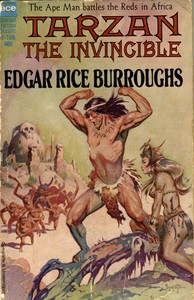
Tarzan the invincible — Edition Insights
(5 User reviews)
1116
Project Gutenberg
2023
Tarzan (Fictitious character) -- Fiction; Fantasy fiction; Adventure stories
Readers of public-domain and historical texts
Project Gutenberg digital edition
en
Edition facts
Words: 76,455
Reading time: 333 min
Text sections: 18
Source:
Project Gutenberg record #71195
In this Tarzan novel, Burroughs interweaves three plot strands: communist agents plotting African rebellion, rival priestesses in Opar, and Tarzan's search for La. The foreword by Richard Lupoff highlights the cinematic cutting technique used to draw these groups together. Excerpts show Tarzan's silent communion with Tantor and the tense aftermath of a failed Opar expedition.
Editorial Edition Score
4.8/5
★★★★★
★★★★★
Calculated from edition completeness, EPUB availability, text structure and catalogue metadata. Not a user rating.
Edition quality
Richard Lupoff's foreword to this Ace edition identifies a hallmark of Burroughs's Tarzan technique: introducing multiple character groups in separate sequences and then cutting between them like a motion picture. In Tarzan the Invincible, those groups are a band of communist agents provocateurs, the rival priestesses of Opar, and Tarzan himself. The excerpts bear out this structure, showing scenes of a nervous camp after a failed Opar assault, the monkey Nkima hurling insults from a tree, and Tarzan lying on Tantor's head in silent communion. The novel's catalog subjects—Tarzan fiction, fantasy, adventure—are accurate but do not capture the political intrigue that the foreword emphasizes.
Cinematic Cutting and Multiple Plot Strands
The foreword explicitly compares Burroughs's method to film editing, and the excerpts confirm that the narrative jumps between distinct locations and character sets. One passage follows a sullen party returning from Opar to find their camp demoralized by a sentry's story of a demon. Another shows little Nkima emerging from a hollow tree to shout threats at the passing column. A third finds Tarzan stretched on Tantor's back, meditating on the disappearance of La. These fragments illustrate how Burroughs withholds the grand pattern until the strands converge. The technique creates suspense not by linear progression but by cross-cutting among simultaneous crises.
The Opar Setting and Its Atmosphere
Opar is presented as a city of crumbling ruins, brown-stained altars, and a mysterious long-drawn scream that seems part of the place itself. A prisoner in a cell with a cement-like floor looks out at a courtyard where an altar stands, uncertain whether a moving shape is man or beast. The description emphasizes decay and menace: the city is a remnant of an ancient Atlantean colony, but the excerpts focus on its immediate physicality—hard surfaces, shadowy darkness, distant stars. The priestesses are mentioned as rivals, but the text gives more sensory weight to the architecture and the uncanny scream than to their characterization.
Tarzan's Relationship with Tantor and Time
One of the most distinctive passages in the excerpts describes Tarzan lying on Tantor's head, chin in cupped hands, engaging in silent communion. The narrative then reflects on Time as a master that drives civilized man but is measureless to Tarzan and Tantor. This philosophical aside is unusual for an adventure story and suggests a contemplative dimension to Tarzan's character. The beasts of the jungle, the text says, acknowledge no master—least of all Time. The passage positions Tarzan outside the frantic pace of human ambition, aligning him instead with the elephant's restful stability. It is a moment of stillness that contrasts sharply with the surrounding action.
Readers approaching Tarzan the Invincible should watch for how Burroughs orchestrates his three groups: the political schemers, the Opar priestesses, and Tarzan. The excerpts give only partial views of each, but the foreword promises that they will eventually intersect. Pay attention to the role of little Nkima, who appears as a comic-relief commentator, and to the way Opar's atmosphere—its ruins, its scream, its altar—functions almost as a character. The novel's length (over 76,000 words) suggests ample room for Burroughs's characteristic pacing between action and reflection.
Noah Robinson
2 weeks agoSophia Baker
4 weeks agoElla Clark
3 weeks agoMatthew Nguyen
6 days ago-

Nathan Bowen - 4 weeks ago
Tarzan The Invincible delivers the expected jungle thrills, with Tarzan as resourceful as ever. The story moves quickly and offers some exciting moments. However, the plot follows a familiar formula, and the supporting characters lack depth. It's an enjoyable read if you're a fan of the series, but not Burroughs' best work. -
Megan Melinda Reynolds - 2 weeks ago
Tarzan The Invincible is a pulse-pounding adventure that reminds me why I love Burroughs' work. The action is relentless, the jungle settings are vividly described, and Tarzan's cunning is on full display. The antagonists are suitably villainous, and the plot keeps you hooked from start to finish. A true classic! -
Scott Meza - 1 week ago
Tarzan The Invincible feels dated and repetitive. The plot is predictable, and the characters are stock archetypes. The prose is serviceable but lacks the freshness it might have had at publication. Burroughs' colonial-era attitudes are jarring today. For modern readers, it may be more of a historical curiosity than a satisfying read.
Reader reflection
Before you leave, reflect on the book
Use these questions to collect your thoughts before moving on.
Your progress
0
/
10
2
What was your overall reaction to the book?
3
Is this a title you would suggest to others?
4
How much effort did this book require?
5
Could you apply anything you learned?
6
Did the book offer a fresh perspective?
7
How personally connected did you feel to the book?
8
Was the book what you thought it would be?
9
Which lesson or insight stayed with you?
10
Joseph Lopez
1 week ago