1

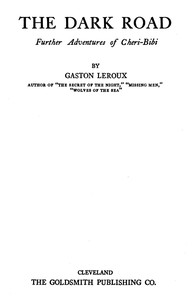
The Dark Road: further adventures of Chéri-Bibi — A Closer Reading
(2 User reviews)
477
Project Gutenberg
2021
Adventure stories; French fiction -- 20th century; Escaped prisoners -- Fiction; Penal colonies -- French Guiana -- Fiction
Readers of public-domain and historical texts
Project Gutenberg digital edition
en
Edition facts
Words: 70,701
Reading time: 308 min
Text sections: 7
Source:
Project Gutenberg record #65459
In this sequel, Gaston Leroux follows escaped convict Chéri-Bibi (Raoul de Saint-Dalmas) from a French Guiana penal colony to a Parisian grocery, contrasting brutal prison life with domestic farce, while the catalog subjects of 'adventure' and 'escaped prisoners' only partially capture the novel's tonal shifts.
Editorial Edition Score
4.7/5
★★★★★
★★★★★
Calculated from edition completeness, EPUB availability, text structure and catalogue metadata. Not a user rating.
Edition quality
The opening chapter, 'The Nut,' introduces a convict resting on a beach after witnessing a double execution, described with visceral detail: 'the hungry sharks, the warders of his prison.' The protagonist, Raoul de Saint-Dalmas, nicknamed 'The Nut' for his refined bearing, is a young man of good family condemned for murder. The narrative immediately establishes a tension between his physical strength and the psychological weight of prison life, as he 'lay resting on his elbows, holding his chin in the cup of his hands, apparently indulging in an impossible dream.'
The catalog subjects list 'Adventure stories' and 'Escaped prisoners — Fiction,' but the excerpt shows a story more concerned with interiority and social observation than action. The convict's nickname, explained in the 'language of the Pré,' signals a world with its own codes, and the execution is described not as spectacle but as something that leaves him 'still shuddering.'
A Prison Vocabulary and Its Social World
The excerpt introduces a specialized lexicon: 'the Pré' for the convict settlement, 'relaxation' as a scheduled break, and 'The Nut' as a term denoting a man 'whom nature has endowed with a fine bearing usually appreciated by women.' This insider language suggests a closed society with its own hierarchies and judgments. The narrator explains that the nickname arose from 'this combination of strength and refinement,' and that in the convict settlement, the Nut 'acted as if he were the master.'
The passage also reveals the prison's brutal routines through offhand references: the executioner Pernambouc and his assistant 'Monsieur Désiré' are named as if familiar figures. The convict's age is given as 'scarcely more than forty,' but prison life 'soon transforms the youngest convict into an old man.' These details build a setting where violence is ordinary and identity is reduced to a nickname.
Domestic Comedy in a Grocery Shop
A later excerpt shifts abruptly to a Parisian grocery run by M. Hilaire and his jealous wife Virginie. The tone changes from grim to farcical: Virginie has 'an execrable temper,' and the couple's quarrel over a young employee named Sarah (called Zoé by the wife) involves 'throwing prunes at each other.' The narrative describes Hilaire's 'love of practical joking' and his wife's habit of threatening to 'stay with her mother until something better turned up.'
The grocery is presented with comic specificity: the two young men who worked there 'left for the war, in which, in fact, they conducted themselves like heroes, and when they returned on leave from time to time each wore stripes on his arm and medals on his breast.' This mundane detail contrasts sharply with the penal colony, yet both settings share a concern with reputation, surveillance, and hidden transactions—Hilaire discovers his wife has 'appropriated forty-two francs fifty centimes' from the till.
What the Catalog Subjects Omit
The catalog labels this work 'Adventure stories' and 'Escaped prisoners — Fiction,' but the excerpts show a novel that oscillates between psychological realism and social satire. The prison section focuses on internal states—the Nut's 'impossible dream' and his shuddering at the execution—rather than escape plots. The grocery section is a domestic comedy with no obvious connection to the convict narrative, suggesting the novel may interweave disparate storylines.
Neither subject heading accounts for the novel's interest in language (the 'language of the Pré'), its detailed social observation (the hierarchy of convicts, the gossip about Hilaire's past as an 'ex-anarchist'), or its tonal range from horror to humor. Readers expecting a straightforward adventure may find instead a work that uses the penal colony as a backdrop for character study and that juxtaposes extreme violence with petty marital strife.
The excerpts offer only fragments of a larger narrative, and the relationship between the convict Nut and the grocer Hilaire remains unclear. Readers should approach The Dark Road as a work that may resist generic expectations, blending modes rather than following a single adventure arc. Pay attention to shifts in tone and setting, and note how Leroux uses specific, concrete details—a nickname, a box on the ear, a sum of money—to build distinct worlds that may or may not converge.
Daniel Scott
2 weeks agoThere are no comments for this eBook.
Reader reflection
Take a moment to reflect on this book
Create a short personal record of your experience with this book.
Your progress
0
/
10
2
How did the book work for you overall?
3
How likely are you to recommend this book?
4
How demanding did the text feel?
5
How original did the book feel?
6
Did this book create an emotional response?
7
Was the book moving at the right speed?
8
How useful were the ideas in this book?
9
What did this book teach you most?
10






Anthony Jones
4 weeks ago