1

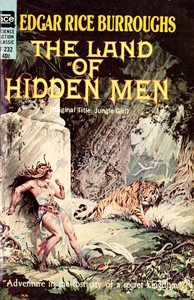
The land of hidden men — Context and Discussion
(6 User reviews)
993
Project Gutenberg
2023
Jungles -- Fiction; Adventure stories; Explorers -- Fiction; Cambodia -- Fiction
Readers of public-domain and historical texts
Project Gutenberg digital edition
en
Edition facts
Words: 72,772
Reading time: 317 min
Text sections: 6
Source:
Project Gutenberg record #70536
An editorial note on Edgar Rice Burroughs' jungle adventure, examining the author's choices in dialogue, description, and structure through the opening confrontation with superstition, the evolving relationship between Gordon King and Fou-tan, and the contrast between modern rationality and ancient mystery.
Editorial Edition Score
4.7/5
★★★★★
★★★★★
Calculated from edition completeness, EPUB availability, text structure and catalogue metadata. Not a user rating.
Edition quality
The novel opens with a pointed dialogue that immediately establishes the central tension: the Cambodian guide refuses to enter the jungle, citing ghosts of the Khmers that no man may look upon and live. Gordon King, a twentieth-century American, dismisses this as 'foolish superstition.' Burroughs uses this exchange to frame the entire adventure as a collision between rational modernity and an older, enchanted world. The guide's fear is not of tigers or elephants but of ancestral spirits—a detail that signals the story will draw on Cambodian lore rather than generic jungle perils.
Dialogue as a Tool of Character and Conflict
Burroughs crafts dialogue that does double duty: it advances the plot and reveals character. The opening conversation between King and the guide is a model of efficiency. The guide's repeated refusals—'I may not enter the jungle'—are met with King's pragmatic arguments about rifles and daylight. Each line tightens the standoff. Later, when Fou-tan calls herself King's slave, he objects: 'You are not my slave.' She insists on the role, saying 'A slave is great in the greatness of his master.' This exchange not only defines their relationship but also hints at the cultural gap between them. King's modern egalitarianism clashes with Fou-tan's inherited notions of hierarchy. Burroughs lets the dialogue carry the weight of these contrasts without editorializing.
Description of the Jungle: Threat and Wonder
The jungle is described in terms that emphasize its otherness. It is 'primitive,' 'untouched by man,' with 'dark shadows' and 'dark aisles' where ghostly processions pass. Burroughs avoids lush, romanticized detail; instead, he focuses on the jungle as a space of negation—a place where the trail ends and human control ceases. The Cambodian's warning about 'the ghosts of my ancestors' gives the landscape a historical depth. Later, when King and Fou-tan find refuge in a gorge, the description shifts to practical details: fish jumping in the stream, the need to hide smoke. This dual register—the jungle as both haunted realm and survival environment—keeps the setting from becoming mere backdrop.
The Unreliable Modern Man
Gordon King is presented as a man of science—a 'graduate physician' and 'perfectly normal product of the twentieth century.' Yet Burroughs undercuts this rationalism with irony. King laughs at the idea of ghosts, but he finds himself 'sitting almost naked under a big rock with a little slave girl of a race that had disappeared hundreds of years before.' He acknowledges the situation is 'preposterous' and 'impossible.' This self-awareness creates a gap between King's identity and his circumstances. Burroughs does not resolve the tension; instead, he lets King's own thoughts reveal the limits of his worldview. The vision of Susan Anne Prentice—a woman from his own world—intrudes, reminding both King and the reader that he is an outsider in this setting.
Recurring Motifs: The Watcher and the Unseen
Burroughs plants a subtle motif of observation. Early in the excerpt, the Cambodian guide speaks of ghosts that 'pass on ghostly elephants.' Later, 'the little eyes of the great man watched them' from the cliff-top. This watcher is not identified; he remains a presence, a pair of eyes. The repetition of watching—first supernatural, then human—creates a sense of being observed without knowing by whom. It is a structural choice that builds unease. Burroughs does not explain the watcher's identity or motives in the provided text, leaving the reader with a question mark. This restraint is effective: the unseen observer becomes a narrative device that hints at larger forces at play.
Burroughs' prose in The Land of Hidden Men is lean and functional, but his authorial choices—the use of dialogue to expose cultural friction, the description of the jungle as a place of both physical and supernatural threat, and the motif of unseen watchers—give the adventure a texture beyond simple plot. Readers attentive to these details will find a story that is as much about the limits of modern certainty as it is about survival in the wild.
-

Zachary Grace Scott - 4 weeks ago
'The Land Of Hidden Men' is a brilliant blend of adventure and mystery. The author has a gift for creating an atmosphere of suspense that is both thrilling and immersive. The plot is intricate, with unexpected twists that keep you turning pages. A truly great book that explores themes of identity and discovery. -
Kelly Lee - 2 weeks ago
'The Land Of Hidden Men' has a strong premise and a well-crafted mystery at its core. However, the pacing is inconsistent, with some sections dragging. The protagonist's motivations are not always clear. That said, it's a solid adventure that will appeal to fans of the genre. -
Margaret Ashley - 1 week ago
Despite its promising title, 'The Land Of Hidden Men' is a slow and convoluted read. The plot is confusing, and the characters are poorly developed, making it hard to stay engaged. The description of the hidden land is interesting, but the storytelling fails to bring it to life. Overall, it's a forgettable experience.
Reader reflection
What was your reading experience?
Capture what you thought, learned, and would like to remember.
Your progress
0
/
10
2
Did this book hold your interest?
3
How likely are you to recommend this book?
4
How demanding did the text feel?
5
Would a second reading be valuable?
6
Did the book give you something worth debating?
7
Was the book moving at the right speed?
8
How distinctive were its ideas or approach?
9
Which lesson or insight stayed with you?
10




Aria Allen
3 weeks ago