1


The Life and Most Surprising Adventures of Robinson Crusoe, of York, Mariner (1801) — A Reader’s Guide
(6 User reviews)
1365
Project Gutenberg
2004
Shipwreck survival -- Fiction; Islands -- Fiction; Crusoe, Robinson (Fictitious character) -- Fiction; Atlantic Ocean -- Fiction; Adventure stories; Castaways -- Fiction
Readers of public-domain and historical texts
Project Gutenberg digital edition
en
Edition facts
Words: 123,479
Reading time: 537 min
Text sections: 13
Source:
Project Gutenberg record #11866
This 1801 edition of Defoe's classic combines the original island narrative with later sequels and a life of Alexander Selkirk, offering a distinct 18th-century compilation. The prose shifts between Crusoe's reflective solitude and vivid action sequences, such as a wolf attack described with military precision.
Editorial Edition Score
4.9/5
★★★★★
★★★★★
Calculated from edition completeness, EPUB availability, text structure and catalogue metadata. Not a user rating.
Edition quality
The 1801 edition of The Life and Most Surprising Adventures of Robinson Crusoe is a composite volume, bundling Defoe's original island narrative with later sequels and a separate account of Alexander Selkirk. The title page promises not only the familiar story of shipwreck and survival but also a “Vision of the Angelic World” and the history of the real-life marooned sailor who partly inspired the fiction. This compilation reflects the 18th-century appetite for expanded, multi-part editions of popular works.
The prose itself is a study in contrasts. In the excerpt provided, Crusoe describes a wolf attack with the measured, tactical language of a military commander: “calling my other servant, and giving him a horn of powder, bid him lay a large train quite along the timber.” The narrator’s voice remains calm even as he recounts a “bloody battle with the beasts,” killing threescore wolves. Yet elsewhere, the same narrator adopts a posture of pious humility, lifting his hands in gratitude for his deliverance. This tonal range—from the practical to the devotional—is a hallmark of the text.
The Narrator's Double Voice
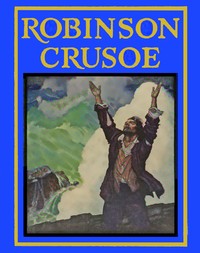
The Crusoe of this edition speaks in two registers. One is the voice of the resourceful survivor, who calculates powder, positions horses, and devises a “cunning stratagem” with a powder train. The other is the voice of the penitent, who reflects on divine mercy. The excerpt opens with a scene of thanksgiving: “I was wrapt up in contemplation and often lifted up my hands, with the profoundest humility, to the Divine Powers.” This duality is not merely stylistic; it structures the narrative itself, alternating between action and reflection.
Readers should note how the narrator frames his own heroism. After the wolf battle, he compares himself to Alexander the Great, but immediately undercuts the boast by describing the wolves as “a legion of devils.” The modesty claimed in the preface—“The story is told with modesty”—is undercut by such comparisons. The tension between self-deprecation and self-aggrandizement is a recurring feature of Crusoe's voice.
The Wolf Attack as Set Piece
The extended wolf episode in the excerpt is a self-contained action sequence, complete with a clear beginning, middle, and end. Crusoe organizes his party in a defensive formation, with horses at the center, and directs a coordinated fire. The description is precise: “giving him a horn of powder, bid him lay a large train quite along the timber.” The narrator dwells on the wolves' howling, their hunger, and their fear of fire, creating a vivid sensory impression.
This episode also serves as a showcase for the narrator's tactical thinking. He notes that the wolves were “insensible of their danger” due to hunger, and that the horses attracted them. The local villagers later confirm this analysis, blaming the guide for leading them through a forest in severe winter. The passage thus functions both as thrilling adventure and as a demonstration of Crusoe's ability to learn from experience—a theme that runs throughout the work.
The Composite Nature of the 1801 Edition
This edition is not a single narrative but a collection. The title page lists “The Life and Most Surprising Adventures,” “His Deliverance Thence, and His After Surprising Adventures,” “His Vision of the Angelic World,” and “The Remarkable History of Alexander Selkirk.” The editorial note in the Project Gutenberg file confirms that multiple tales have been “incorporated into this e-book taken from an 1801 edition.” Readers encountering the text should be aware that the voice and focus may shift between sections.
The inclusion of Selkirk's history is particularly notable. Selkirk, a real sailor marooned for four years, provides a factual counterpart to Crusoe's fictional twenty-eight-year isolation. The juxtaposition invites comparison between the two accounts, though the excerpt does not reveal how the Selkirk narrative is presented. The edition's structure suggests an 18th-century interest in authenticating fiction through documentary evidence.
Diction and the Rhetoric of Danger
The language of the wolf attack is marked by hyperbole and martial imagery. Crusoe describes the wolves as “a legion of devils” and claims that “never in my life was I so sensible of danger.” He estimates their number at three hundred, though the actual count of wolves killed is sixty. The narrator's tendency to exaggerate serves to heighten the drama, but it also raises questions about reliability.
Compare this to the more measured tone of the preface, which promises “the wonders of this man's life” but insists on modesty. The gap between the preface's claim and the narrative's rhetoric is instructive. Crusoe's voice is not uniform; it adapts to the situation, becoming more elevated in moments of crisis. This flexibility is a deliberate authorial choice, allowing Defoe to vary pace and intensity across the long work.
This edition rewards attention to its composite structure and the shifting registers of its narrator. Readers may wish to compare the tone of the island sections with the later adventures in France, noting how the narrator's voice changes. The inclusion of Selkirk's history also invites reflection on the relationship between fact and fiction in early adventure writing. Approach the text as a layered document, not a single unified story.
There are no comments for this eBook.
Reader reflection
What was your reading experience?
Capture what you thought, learned, and would like to remember.
Your progress
0
/
10
2
Was reading this book enjoyable?
3
Would you pass this book on to a friend?
4
Did the language feel accessible?
5
Is this a title worth rereading?
6
Did this book create an emotional response?
7
What did you appreciate most?
8
How clear did the writing feel?
9
Which lesson or insight stayed with you?
10






Samuel Ramirez
2 weeks ago