1

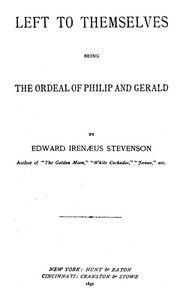
Left to Themselves: Being the Ordeal of Philip and Gerald — Edition Insights
(3 User reviews)
789
Project Gutenberg
2018
Boys -- Fiction; Adventure stories; Voyages and travels -- Fiction; Gay teenagers -- Fiction
Readers of public-domain and historical texts
Project Gutenberg digital edition
en
Edition facts
Words: 66,052
Reading time: 288 min
Text sections: 22
Source:
Project Gutenberg record #57203
An editorial note examining how Edward Prime-Stevenson's 1891 adventure novel uses empty houses, delayed encounters, and domestic routines to structure the ordeal of two boys stranded without adults.
Editorial Edition Score
4.8/5
★★★★★
★★★★★
Calculated from edition completeness, EPUB availability, text structure and catalogue metadata. Not a user rating.
Edition quality
From its first pages, Left to Themselves establishes a pattern of spaces that are inhabited yet absent of people. When Philip Touchtone explores the Probasco house, he moves through rooms described as “clean, cheerful, and in stiff and even polished order” but finds no one home. The house becomes a stage for self-sufficiency: Philip decides to “take possession,” ration food, and even milk the cow. This recurring image of a furnished but empty dwelling—a house that is “one thing, living in it was another”—structures the boys’ ordeal as a series of provisional occupations.
Empty Houses and Provisional Homes
The Probasco house is the first of several domestic interiors the boys enter without permission. Philip’s inventory—three loaves of bread, a pound-cake, a partly cut ham—reads like a survival checklist. The dog’s hunger and the cat’s arrival reinforce that these are spaces meant for living, yet the inhabitants are absent. Later, the boys examine “the garden and sheds and stables,” finding a cow that “began complaining so sorely at being unmilked.” These details turn the house into a puzzle: who are the Probascos, and why did they leave? The narrative withholds answers, forcing Philip and Gerald to act as temporary stewards rather than guests.
Movement Between Scenes: From Sea to Shore to Interior
The story’s structure relies on abrupt transitions. The excerpt shows Philip moving from the “lower hall” to the attic, then back to the kitchen, then outside to fetch Gerald. Each shift is marked by physical symptoms—Philip’s head grows “giddy,” he feels “a great faintness”—tying bodily exhaustion to spatial exploration. The whistle-calls and the dog’s leaping create a sensory thread linking exterior and interior. This pattern of entering, assessing, and retreating recurs throughout the novel, making each new location a test of the boys’ resourcefulness.
Recurring Details: Food, Fatigue, and Animal Companions
Food appears as both necessity and moral boundary. Philip refuses to eat until Gerald joins him, a small gesture of loyalty. The meal they share is “more ample than was altogether prudent,” a rare moment of abundance. Animals—the dog Towzer, the cat, the cow—serve as silent witnesses and co-dependents. The cow’s “complaining” prompts Philip to milk her, turning a chore into an act of care. These recurring details ground the adventure in the mundane: survival means managing hunger, exhaustion, and the needs of creatures who cannot speak.
The Preface as a Clue to the Novel’s Ambitions
Prime-Stevenson’s preface, addressed only to adults, argues that young readers value “character in fiction” and “the impression of downright personality” over mere incident. He warns against “writing down to childhood.” This editorial stance suggests that Left to Themselves aims for psychological depth within an adventure framework. The preface’s existence—and its instruction that children should skip it—creates a layered readership. The novel’s structure, with its deliberate pacing and focus on interior spaces, may reflect this belief that “what happens” matters less than how the boys respond to being left alone.
Readers attentive to setting will find that the empty houses and delayed encounters are not gaps in the plot but deliberate devices. The novel rewards those who notice how Philip and Gerald transform abandoned spaces into temporary homes. Pay attention to what the boys choose to touch, eat, or leave behind—these small decisions reveal character more than any dramatic event.
Liam Scott
4 weeks agoSophia Martinez
1 month ago-

Kyle Deborah Duran - 2 weeks ago
{'review_type': 'neutral', 'content': 'Left To Themselves has a classic, wholesome feel and the central friendship is genuinely sweet. The adventures are engaging, but the plot is somewhat predictable and the language may feel dated to modern readers. Still, it’s a quick, enjoyable read for fans of vintage children’s literature, and the moral lessons are timeless.'} -
David West - 2 weeks ago
{'review_type': 'negative', 'content': "Left To Themselves is outdated and preachy. The dialogue is stilted, and the boys' actions are unrealistic even for the time period. The story lacks tension, as every problem is resolved conveniently and without real consequence. While it may have appealed to readers in its era, today it feels dull and moralizing. I found it difficult to get through."} -
Gail Shepard - 1 week ago
{'review_type': 'positive', 'content': 'Left To Themselves is a touching and adventurous story about Philip and Gerald, two boys who must rely on their wits and each other when they are left to fend for themselves. The author captures the essence of youthful courage and friendship with heartwarming authenticity. The trials they face are both thrilling and believably portrayed, making this a classic for young readers. It’s a delightful read that will resonate with anyone who loves stories of resilience and camaraderie.'}
Reader reflection
Record your reading impressions
A brief reflection can help important ideas stay with you longer.
Your progress
0
/
10
2
How much did you enjoy the reading experience?
3
Would you pass this book on to a friend?
4
What was the reading difficulty like?
5
Would you like to discuss this book with someone?
6
How did the pace of the book feel?
7
Did any part of the book stay with you emotionally?
8
Which aspect of the book did you value most?
9
In one sentence, what did you learn?
10
Emma Young
2 weeks ago