1

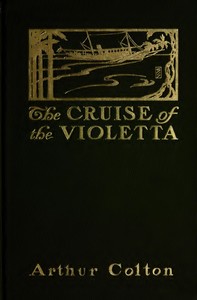
The Cruise of The Violetta — Background and Themes
(3 User reviews)
593
Project Gutenberg
2015
Rich people -- Fiction; Yachts -- Fiction; Voyages and travels -- Fiction; Missions -- Fiction
Readers of public-domain and historical texts
Project Gutenberg digital edition
en
Edition facts
Words: 49,517
Reading time: 216 min
Text sections: 8
Source:
Project Gutenberg record #50272
A narrator recovering from yellow fever in Nassau falls in with Dr. Ulswater, whose yacht Violetta carries a wealthy, eccentric company through adventures involving a Hindu magician, missing dolls, and a mission station, told via nested manuscripts and comic verse.
Editorial Edition Score
4.7/5
★★★★★
★★★★★
Calculated from edition completeness, EPUB availability, text structure and catalogue metadata. Not a user rating.
Edition quality
The Cruise of the Violetta opens not at sea but in the aftermath of a fever, with the unnamed narrator convalescing in Nassau under the care of Dr. Ulswater. The doctor’s method of recovery is peculiar: he hunts cuttlefish in the harbour shoals with a three-pronged spear, calmly letting their tentacles slap around his neck while he dissects them. This early image—clinical yet absurd—sets the tone for a narrative that moves between precise observation and playful extravagance. The story is framed as a collection of manuscripts, with Dr. Ulswater’s first-person accounts embedded within the narrator’s own recollections, creating a layered structure that shifts between voices and locations.
A Frame of Manuscripts and Voices
The book’s structure is built around nested documents. The narrator introduces Dr. Ulswater, who then takes over the story through a series of manuscripts titled “First Document,” “Second Document,” and so on. These internal narratives are interrupted by the narrator’s own resumptions, as in Chapter XXIII: “I Resume the Narrative.” This technique creates a deliberate distance between events and their telling. The reader is always aware of a mediating hand—Ulswater writing, the narrator editing, and occasionally footnotes appearing. The effect is less a straightforward voyage chronicle than a puzzle of perspectives, where the reliability of any single account is subtly questioned.
Recurring Images: Custard, Cuttlefish, and Disappearance
Certain images recur across the excerpts, binding the disparate episodes together. The cuttlefish hunt in Nassau is echoed later when Ram Nad, the Hindu magician, performs a trick that reduces objects—and even people—to a state Susannah describes as “like custard that was all around everywhere.” The narrator’s earlier fever-induced wasting finds a comic parallel in the magician’s ability to dissolve matter. The custard metaphor is precise and odd, linking bodily fragility to magical transformation. Similarly, the act of disappearance—first of cuttlefish into Ulswater’s knife, then of dolls and Susannah into Ram Nad’s basket—becomes a structural motif, each vanishing act followed by a reappearance that defies explanation.
Movement Between Scenes: From Harbour to Palace to Deck
The narrative moves restlessly between settings, each shift marked by a change in tone. The opening in Nassau’s harbour is intimate and observational, focused on the physical details of cuttlefish and convalescence. Later scenes jump to the deck of the Violetta, where Ram Nad’s magic show turns into a chaotic dance, with Sadler chanting nonsense verse. The setting of the Island of Lua and its palace (mentioned in chapter titles) suggests a more formal, perhaps colonial, backdrop. These transitions are abrupt, often mediated by the manuscript structure: a chapter break can transport the reader from a philosophical aside to a slapstick reunion. The effect is a deliberate instability, as if the voyage itself is less a linear journey than a series of disconnected performances.
The Role of Verse and Nonsense
Embedded within the prose are snatches of ballad and chant. Sadler’s “tralala” refrain and the “Ballad of Georgiana and Delores” (Chapter XX) indicate that the book incorporates verse as a counterpoint to the narrative. Susannah’s dismissal of the ballad—“That’s no good now. It isn’t so.”—suggests that the poems are provisional, subject to revision by events. The verse is not decorative but functional: it provides a rhythmic release from the doctor’s analytical tone and introduces a folkloric element. The narrator’s own exclamation “Susannah, hosannah!” turns a moment of discovery into a quasi-religious chant, blending the sacred and the ridiculous. This mixing of registers—clinical, magical, lyrical—is central to the book’s peculiar texture.
Readers should attend to the gaps between the manuscripts: what is left out of Ulswater’s accounts may be as important as what is included. The narrator’s editorial presence is minimal but pointed, and the footnotes (mentioned in chapter titles) may offer clues. The book rewards attention to its structural quirks—the nested voices, the sudden shifts in scene, the recurring metaphors of dissolution and recovery. Approach it not as a conventional sea story but as a cabinet of curiosities, where each chapter opens a new drawer.
Luke Torres
2 weeks agoLeo Martin
4 weeks ago-

Larry Wiley - 4 weeks ago
{'review_type': 'neutral', 'content': "The Cruise Of The Violetta offers a pleasant, episodic journey with charming descriptions of ports and people. While the writing is engaging, the lack of a strong central conflict makes the story feel meandering at times. It's enjoyable if you prefer a leisurely narrative, but those seeking a plot-driven read might be less satisfied."} -
Mary Megan Green - 3 weeks ago
{'review_type': 'negative', 'content': 'The Cruise Of The Violetta is a dated, slow-moving travelogue with little in the way of plot or character development. The protagonist is passive, and the episodic structure becomes monotonous. The prose is overly descriptive but fails to evoke genuine emotion. I struggled to stay engaged and ultimately found the journey tedious.'} -
Timothy Brown - 1 week ago
{'review_type': 'positive', 'content': "The Cruise Of The Violetta is a delightful maritime adventure that captures the spirit of exploration and romance. The narrative flows beautifully, with vivid depictions of life at sea and the diverse characters encountered along the way. It's a perfect escape, blending humor and poignancy. A true gem for fans of classic travel tales."}
Reader reflection
Before you leave, reflect on the book
Use these questions to collect your thoughts before moving on.
Your progress
0
/
10
2
What was your overall reaction to the book?
3
Would you pass this book on to a friend?
4
How much effort did this book require?
5
Did anything about the book feel genuinely new?
6
How clearly were the main ideas presented?
7
Did the book deliver what you hoped for?
8
Could you apply anything you learned?
9
What is the main idea you are taking away?
10








Aria Scott
2 weeks ago