1

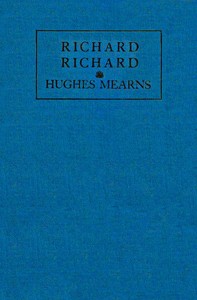
Richard Richard — Reading Companion
(6 User reviews)
1465
Project Gutenberg
2023
New York (State) -- Fiction; Man-woman relationships -- Fiction; Voyages and travels -- Fiction; Families -- Fiction
Readers of public-domain and historical texts
Project Gutenberg digital edition
en
Edition facts
Words: 112,407
Reading time: 489 min
Text sections: 29
Source:
Project Gutenberg record #71263
Hughes Mearns' 1921 novel follows Richard, a man who borrows money from a stranger on a steamer, then later swims across Lake Keuka to escape a situation, encountering a cast of characters including Phœbe Norris and Captain Wells. The narrative shifts between shipboard encounters and lakeside life, with a tone that blends dry humor and introspection.
Editorial Edition Score
4.9/5
★★★★★
★★★★★
Calculated from edition completeness, EPUB availability, text structure and catalogue metadata. Not a user rating.
Edition quality
The novel opens with a precise, almost theatrical scene: a man lounging on a steamer rail in Naples, watching passengers disembark, and silently deciding to borrow money from a woman he has not yet met. This moment—the unnamed stranger who becomes a lender—sets a pattern of impulsive, self-aware decisions that recur throughout the excerpts. The prose is lean, with sharp observations: the woman is described as a 'clean-cut, tailor-made figure,' and the man's internal calculation is stated baldly, without apology.
Mearns uses shipboard etiquette as a narrative device, allowing strangers to converse without introduction. The dialogue is clipped and natural, and the setting—Naples, then Lake Keuka—shifts from the crowded port to a quiet lakeside where Richard swims away from a transaction involving a swapped suit. The tone is dry, with moments of wry humor, as when Phœbe calls Richard a 'villain' and imagines him as a 'fine movie actor.'
The Art of the Unspoken Bargain
The excerpts reveal a recurring interest in transactions that are not quite financial. Richard borrows money from a woman he has just met, and later, Phœbe Norris trades a cotton bathing suit for a Norfolk jacket, calling it a 'good bargain.' These exchanges are presented without moral judgment; instead, they highlight a pragmatic, almost playful approach to social and material exchange. The narrative voice treats these bargains as natural, even amusing, rather than deceitful.
This pattern extends to the way characters assess one another. Phœbe, for instance, sizes up Richard by his swimming stroke and his silence, concluding that his 'silence had put a spell on her cabin.' The novel seems to explore how people read each other through actions rather than words, and how unspoken agreements—like the loan or the suit swap—create bonds that are both practical and ambiguous.
Swimming as Escape and Self-Discovery
Richard’s swim across Lake Keuka is the most vividly rendered action in the excerpts. The lake is described with geographic precision—'shaped like a mitten with a very large thumb'—and the swim becomes a physical and psychological journey. As he swims, Richard’s spirits rise, and he resolves 'to be true to nothing but himself.' The water is 'tonic to the will,' and the act of swimming allows him to shed his shyness and find strength.
This sequence contrasts with the earlier shipboard scenes: on the steamer, Richard is passive, lounging and watching; in the lake, he is active, propelling himself across miles of open water. The swim also introduces other characters, like Captain Wells, and leads to a reunion with Phœbe. The lake setting—Bluff Point, the cat-boat, the 'stately little yacht'—grounds the narrative in a specific, tactile landscape.
Voice and the Shifting Register
Mearns’ prose moves between registers with ease. The opening chapter uses a formal, almost reportorial style: 'An angular chap in proper steamer négligé lounged contentedly.' Later, the dialogue shifts to colloquialisms: 'Sure it’s a fine movie actor he’d make,' Phœbe says, affecting an Irish brogue. The narrative voice also includes literary allusions, as when Richard quotes Matthew Arnold: 'Resolve to be thyself.'
This variety suggests a narrator who is both detached and playful, capable of shifting from observation to interior monologue. The excerpts also show a fondness for naming—'Sago-ye-wat-ha,' 'Tshoti-non-da-waga'—which hints at a broader interest in place and language. The tone is never sentimental; even moments of introspection are undercut by dry humor, as when Phœbe wonders if she is suffering from 'a guilty conscience or a desire to gad.'
Readers may find it useful to attend to the novel’s treatment of money and obligation. The opening loan is never mentioned again in the excerpts, but it establishes a dynamic of unspoken debt that may recur. Similarly, the swim—a literal and figurative crossing—may signal a pattern of movement and return. The novel’s title, Richard Richard, suggests a doubling or self-reflection that the excerpts only begin to explore.
-

Justin Porter - 1 month ago
{'rating': 2, 'text': 'Richard Richard attempts a deep psychological exploration but ends up being excessive and self-indulgent. The narrative loses its way in endless philosophical musings, leaving the plot scattered and the characters unrelatable. The experimental prose is pretentious rather than profound. As a reader, I found it a chore to finish, and the lack of a clear message or resolution is frustrating. Not recommended for those seeking a coherent story.'} -
Joseph Mccarthy - 4 weeks ago
{'rating': 5, 'text': "Richard Richard is a masterful character study that delves deep into the human psyche. The narrative is introspective, following a man plagued by his own contradictions and societal expectations. The prose is elegant, and the author captures the subtleties of emotion with precision. It's a thought-provoking journey that challenges the reader's perceptions. A literary gem that deserves acclaim and a place on every serious reader's shelf."} -
Melissa Lopez - 1 week ago
{'rating': 4, 'text': "Richard Richard is an intellectually stimulating novel that focuses on inner conflicts and identity. The character's development is well-handled, and the writing style is refined. However, the plot is minimal, and some readers might find the slow pace and heavy introspection tedious. If you appreciate character-driven fiction, this will resonate, but others may long for more action. Overall, a quality work with a niche appeal."}
Reader reflection
Record your reading impressions
A brief reflection can help important ideas stay with you longer.
Your progress
0
/
10
2
Was reading this book enjoyable?
3
Would you pass this book on to a friend?
4
Did the language feel accessible?
5
Was the book easy to understand?
6
How original did the book feel?
7
How well did it match your expectations?
8
Did you relate to its people, ideas, or situations?
9
In one sentence, what did you learn?
10




Joseph Sanchez
2 weeks ago